
The history of ecommerce
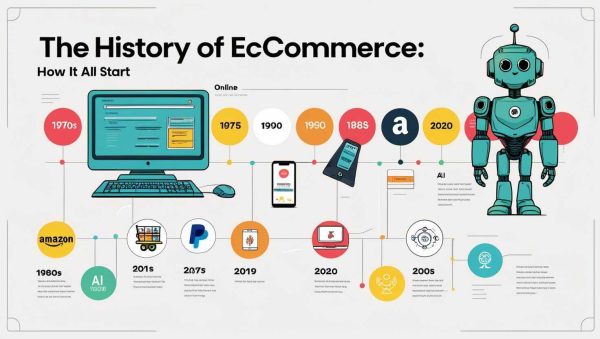
The story of online shopping: a story of visionairs, pioneers and entrepreneurs
Online Shopping’s Earliest High Notes:
1969 — CompuServe is founded as an immediate front runner in creating online services such as electronic mail and online live chat services. CompuServe was later acquired by AOL in 1998.
1979 — Michael Aldrich invents online shopping. This is ecommerce in its earliest form. He creates a system that processes transactions between consumers and businesses or from business to business. He modifies a television and connects it to a transaction processing computer using a telephone line. This process, however, was not fully realized until the introduction of the internet in the 90s when people could take advantage of online sales.
1982 — Boston Computer Exchange launches the first ecommerce business and sells used computers online.
1989 — Tim Berners-Lee invents the first web server and by the end of 1990. The web server was up and running at CERN, Berners-Lee employer at the time. He started working with other computer scientists at the time to help develop the server that would become the worldwide web.
The early 90s and introduction of the Internet
1993 — The source code for the first web browser, invented by Berners-Lee, is released to the public. This grants public access to the world wide web for the first time.
1995 — The National Science Foundation lifts its restriction on commercial use of the NET. This gives users the rights needed to start an online business and allow online shopping to take shape, leading to the launch of many well-known ecommerce platforms that are still thriving today.
1995 — eBay, one of the first and popular ecommerce sites for people to sell products is introduced. Also, Jeff Bezos launches a little online bookstore now known as Amazon. By the end of 1996, he sees $15.7 million in revenue.
1998 — PayPal creates a payment processing system for ecommerce and is now one of the largest most trusted online payment platforms in the ecommerce industry.
The early 2000s and the dawn of ecommerce
2000 — Google introduces Google AdWords giving a “one-stop-shop” to both online and brick-and-mortar businesses looking for easy online advertising solutions.
2005 — Etsy launches and is now one of the most popular third-party online marketplace platforms for anyone to easily start selling online.
2006 — Shopify launches its storefront software that was created out of frustration with past storefront systems that were too complicated and expensive. Shopify helped bring simple software for small business owners to start an ecommerce business.
2009 — Ecwid introduces a revolutionary way to start an ecommerce business. Ecwid started out as a few lines of code that you could include in your website to create an online store. It was a new hands-off approach that allowed online businesses to create a storefront without constant monitoring by the ecommerce platform.
The modern-day online store
2011 — Facebook launches sponsored stories as a form of early advertising.
2014 — Apple brings Apple Pay to their iPhone. Apple Pay is by far one of the most popular mobile payment systems in use today. The introduction of the wallet and Apple Pay has made it even easier for consumers to purchase items by using their iPhones.
2016 — Instagram starts testing their shoppable features in the app. Instagram’s parent company Facebook also introduced Facebook Marketplace and added a payment function into the Messenger app.
2017 — The Ecommerce market rises to new heights. Cyber Monday sales hit a new record by exceeding $6.5 billion in revenue from online sales, 17% increase from 2016.
2020 — Ecommerce grows exponentially due to the Covid-19 pandemic. Lockdowns force brick and mortar stores to adapt to the digital world and provide more goods and services online.